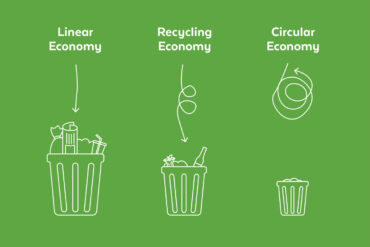
Modern economic systems are deeply connected to how society extracts, uses, and disposes of natural resources. Over time, different economic models have emerged to address efficiency, sustainability, and environmental impact. Among the most widely discussed are the Linear Economy, Recycling Economy, and Circular Economy.
These three frameworks represent different stages of economic thinking—from traditional consumption-driven systems to more sustainable and regenerative models designed to reduce waste and preserve resources for future generations.
.
What is a Linear Economy?
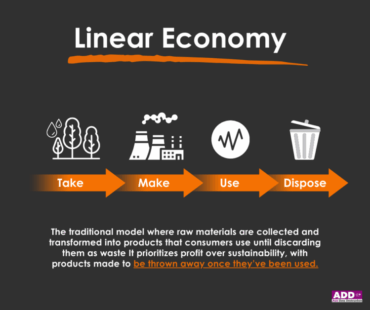
The Linear Economy is the traditional economic model that follows a simple flow:
Take → Make → Use → Dispose
In this system, raw materials are extracted from nature, transformed into products, consumed by users, and then discarded as waste. It is often described as a “take-make-waste” model.
A key characteristic of the linear economy is the assumption that natural resources are abundant, and waste disposal is inexpensive. As a result, products are typically designed with a primary focus on maximizing short-term economic value, rather than considering their full environmental or social impact throughout the product lifecycle.
However, this model creates significant long-term challenges:
– Over-extraction of natural resources Increasing levels of environmental pollution
– Growing volumes of industrial and electronic waste
– Contribution to climate change and ecosystem degradation
As global population and consumption continue to rise, the linear economy is becoming increasingly unsustainable. Many industries are now under pressure to shift toward more responsible and resource-efficient systems.
.
What is a Recycling Economy?
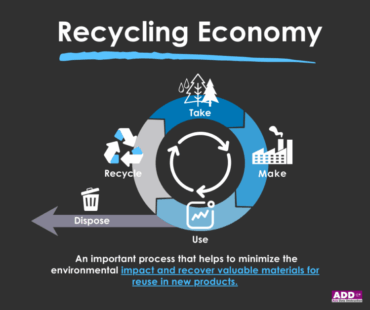
The Recycling Economy is an improved approach that focuses on recovering waste materials and converting them into new usable products. Instead of disposing of materials after use, this model aims to extend the lifecycle of resources through recycling processes.
In a recycling economy, materials such as plastic, metal, glass, paper, and electronic components are collected, sorted, and processed to create new raw materials or finished goods. This reduces dependency on virgin resources and helps minimize landfill waste.
Key characteristics include:
Collection and sorting of waste materials Processing waste into reusable raw materials Development of recycling infrastructure and systems Creation of new economic value from discarded materials
This approach also generates economic opportunities by supporting industries involved in waste management, recycling technology, and material recovery. It creates jobs while contributing to environmental protection.
However, recycling alone is not a complete solution. It still requires energy, infrastructure, and cannot fully eliminate waste generation. This is why it is often seen as a component of a broader system rather than a standalone solution.
.
What is a Circular Economy?
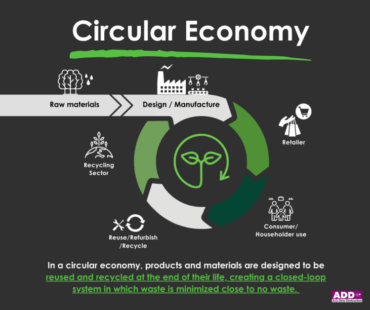
The Circular Economy is a more advanced and holistic economic model designed to eliminate waste entirely and keep resources in continuous use for as long as possible.
Unlike the linear model, the circular economy is based on a closed-loop system where materials are continuously reused, repaired, refurbished, and recycled.
The concept is built on three core principles:
– Design out waste and pollution
– Keep products and materials in use
– Regenerate natural systems
In a circular economy, products are designed from the beginning with their entire lifecycle in mind. This includes durability, repairability, and recyclability. Instead of becoming waste, materials are reintegrated into the production cycle.
This model offers several major benefits:
– Reduced environmental impact
– Lower demand for raw material extraction
– Decreased greenhouse gas emissions
– Improved resource efficiency
– Long-term economic resilience
The circular economy is increasingly seen as a necessary transformation to address global challenges such as climate change, resource depletion, and biodiversity loss.
.
How is the Circular Economy different from the Recycling Economy?
Although both the Recycling Economy and Circular Economy aim to improve sustainability, they are fundamentally different in scope and philosophy.
The Recycling Economy focuses primarily on processing waste materials and converting them into new products. Its main goal is to reduce landfill waste and decrease the need for virgin resources. However, it still operates largely within a traditional production-consumption model.
In contrast, the Circular Economy is a much broader system that redesigns the entire economic lifecycle. It focuses not only on recycling, but also on:
Product design optimization
Waste prevention at the source
Repair and refurbishment
Reuse and sharing models
System-wide resource efficiency
While recycling is one component of the circular economy, it is not the foundation. The circular model emphasizes preventing waste before it is created, rather than managing it after it exists.
In summary:
Recycling economy = focuses on waste processing
Circular economy = focuses on system redesign and waste elimination
Both approaches contribute to sustainability, but the circular economy represents a more complete transformation of how economies operate.
.
Role of Sustainable IT Asset Management
In modern industries, especially in technology-driven sectors, sustainability also extends to IT infrastructure and electronic waste (e-waste).
Organizations are increasingly adopting responsible asset disposition strategies to reduce environmental impact while recovering value from retired equipment.
For example, companies like Asia Data Destruction support environmental sustainability by ensuring that IT equipment is properly handled at the end of its lifecycle. This includes secure data destruction, safe disposal of hazardous components, and recovery of valuable materials for reuse.
Such practices contribute to both environmental protection and resource efficiency by:
Preventing improper e-waste disposal
Ensuring secure data destruction
Recovering reusable components
Supporting sustainable recycling processes
.
In conclusion, the concepts of Linear Economy, Recycling Economy, and Circular Economy demonstrate the evolution of resource use, ranging from a “take-make-dispose” system to approaches that aim to reduce and prevent waste at the source.
At the same time, sustainability has also expanded into the technology sector, particularly in IT asset management and electronic waste (e-waste), which play an important role in reducing environmental impact and improving resource efficiency.
When organizations adopt practices such as responsible asset disposal, secure data destruction, and proper recycling processes, they help support data security, business value, and environmental sustainability simultaneously.
Therefore, the shift toward sustainable economic systems and resource management is not just an option, but an essential direction for the future of both businesses and the planet.

 ไทย
ไทย 日本語
日本語 Tiếng Việt
 ភាសាខ្មែរ